Search This Blog

Saturday, February 26, 2011

Early Residents – William Deemer & W.T. Dickson

William Deemer is thought to have been the same William Deemer who applied for the license of the Springwood Hotel (later re-built and renamed the Oriental Hotel by James Hunter Lawson) in June 1885.  An objection was made to the court regarding his application for the license because he had a charge of intoxication against him.  However, the court was lenient and the license was granted.  William is thought to have married Adelaide C. Smith in 1861 and several children had been born prior to their move to Springwood.  William is thought to have retained the license until approximately 1888 when the Adams family took over the running of the hotel.
W.T. Dickson was the licensee of the Royal Hotel in 1884.  It would seem he brought a good deal of experience in the hotel industry when he came to Springwood because he was late of the York Hotel situated in York Street, Sydney.  His stay was short because 1885-6 the license was in the name of Mary Ann Brown.    
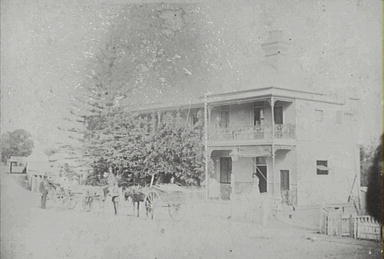
Royal Hotel Great Western Road (now Macquarie Road)

Early Residents - Thomas Boland

Early Residents: Thomas Boland
Thomas is commonly known as “the father of Springwood.’ He was born in Tipperary Ireland about 1810 according to the age recorded on the passenger list for the Strathfieldsay on which he immigrated to Australia with wife Mary Ann and daughter Mary in 1838.  The following year Henry Parkes (later Sir) travelled to Australia on the same ship.  This is said to have created a link between the two men leading to friendship in later life.
Thomas and Mary were Catholic and literate, and he brought excellent references from Sir P.P. Carrol and others. Joseph Jackson wrote that the Boland family went to Bathurst where Thomas was said to have been overseer manager for the Ranken family as well as overseer in a cheese factory.[1]  However, his obituary in the Nepean Times 30th March 1889 stated that he worked in Bathurst for Perrier Brothers.[2]  The Perriers and Rankens were early pioneers in the Bathurst district.
He is recorded as holding the license for the Bathurst Traveller 1841-4 also known as the Weatherboard Inn at Weatherboard (now Wentworth Falls).  In 1843 he is shown as holding the publican’s license for the Trafalgar Inn, Honeysuckle Flat, a district of Bathurst. He was appointed superintendent of road gangs at Springwood following his move from Bathurst.  In 1847, the land on which the second military barracks had been built was sold to Robert Martin, who sold it to Thomas Boland the same year.
The 20 acre site contained a slab hut with three bedrooms, a sitting room, pantry, detached kitchen, storerooms and stables.  There was a garden well supplied with water from a dam.  Thomas, with inn-keeping experience and time spent working on the western road, could see the need for an inn to serve travellers. 


Springwood or Boland's Inn
He consequently built the Springwood Inn, often known as Boland’s Inn and held the license in 1857.  Daughter Alice recounted visits made to the inn by Sir Henry Parkes, Sir James Martin and the Hon. W.B. Dalley.  Caroline Chisholm, with bands of young women immigrants also stayed at the inn.  Large numbers of Chinese camped in the ground adjacent on their way to the goldfields.
Shirley Evans
This is an abbreviated version of a larger article found in The Making of a Mountain Community: a Biographical Dictionary of the Springwood District, 2002.


[1] Joseph Jackson Papers, Blue Mountains City Council local studies collection, vertical files.
[2] Nepean Times, 30th March, 1889.

Friday, February 25, 2011

Law & Order: Constable John Illingworth

John Illingworth, Springwood’s first Police officer, was born in Springwells in Yorkshire in 1852.  He learned the trade of bolt maker in his father’s business but is believed to have gone to sea for some years. 
Around 1875 he married Frances Mary Grainger and their first child Rosa was born in 1876, followed by Charley who died soon after his birth in 1879.  The Illingworths decided to make a fresh start in the colonies and John set off ahead of the family, arriving in Sydney in 1879 on the vessel Hankow.  Presumably Frances and Rosa followed soon after.  On the13th April 1880 he was sworn in as a constable of the New South Wales Police Force.
Police records describe John as being 5 feet 10 inches tall with blue eyes and brown hair, fresh complexion and good general appearance.  John was transferred to the Eastern District on 17th May 1880 and he is understood to have been stationed at Parramatta before his appointment as the first permanent police officer at Springwood in 1881.
There had been local pressure for a police presence in Springwood from around the late 1870s with representation being made to Sir Henry Parkes.  While a lock-up was provided in 1879 it was not until 1881 that a combined station and residence was built on the site of present-day Manners Park.

Old police lock up left of picture
In May 1891 John Illingworth was transferred to Katoomba Police Station as officer-in-charge.  As a mark of their esteem the citizens of Springwood farewelled him with a function at Rayner’s Hall.  Following a speech by Mr. Rayner, John was presented with a beautifully illuminated and framed address accompanied by a purse of sovereigns.[1]
John’s duties at Katoomba also included those of Clerk of Petty Sessions and during his tenure he was promoted to senior constable.  On 31 March 1897 he left Katoomba to take up a position at Richmond Police station where he spent 10 years before transferring to Granville in March 1907.  He was promoted to sergeant second class on 1st January 1908.  John Illingworth achieved fame in what would now be regarded as a somewhat obscure field; the game of checkers or draughts.  In Stearns’s Book of Portraits-Prominent Players Volume ii, published in 1898, his photograph is published over a text which states that he ‘is one of the best known players in Australia.’
John Illingworth died on 3rd May 1913.  Illingworth Road, Yellow Rock commemorates Springwood’s first police officer.
Peter Chinn
Ref:
Nepean Times
Beverley Dodd Woodford (daughter of Bertha Illingworth)
Stearn’s Book of Portraits-Prominent Players Volume 11
This an abbreviated version of a longer article in The Making of a Mountain Community: a Biographical Dictionary of the Springwood District.


[1] Nepean Times, 13.6.1891.

Thursday, February 24, 2011

Early Residents - Geoffrey Eagar & A. Stewart


Geoffrey Eagar
We have no information about A. Stewart but Geoffrey Eagar is quite famous.  He was one of several parliamentarians that resided – mainly part time – in the Blue Mountains in the nineteenth century.  Eagar was son of convict Edward Eagar who received a conditional pardon in 1813 from Governor Lachlan Macquarie.  Eagar senior became one of the richest businessmen in the colony and was a shareholder in the Bank of New South Wales.  Geoffrey was born in 1818 and received his education by attending the schools of J.D. Lang and W.T. Cape.  In 1843 he married Mary Ann Bucknell. 
Geoffrey worked for various mercantile firms until he joined the staff of the Bank of New South Wales and his resignation in 1859 signalled a move into politics and the New South Wales Legislative Council where he joined with former school friends William Forster, James Martin and John Robertson.  His career was somewhat turbulent and after resigning from the Forster ministry in 1860, returned to the political stage in 1863 when James Martin replaced Cowper as Premier.  Under Martin he attained the position of Colonial Treasurer where his previous bank experience stood him in good stead.  He met with resistance however when he tried to bring the Customs Department under the control of Treasury.  He experienced resistance from W.A. Duncan who had powerful supporters like Henry Parkes.  Eagar resigned from the ministry again in 1868.  As the Premier, James Martin found a place for Eagar in Treasury in 1871 when he was facing financial difficulties.  Eagar, a well-known poet and essayist, was Chair of the Civil Service and History Boards and in the latter position recommended the publication of the Historical Records of NSW.  He died in 1891.
This is part of a longer article found in The Making of a Mountain Community: A Biographical Dictionary of the Springwood District, 2002.

Early Residents - D.T. Dawson, William Deane

Although we do not know anything about D. T. Dawson, William Deane was most probably the son of musician John Philip Deane. The Deane family moved to Sydney from Hobart in the 1850s after the latter man spent a short time in prison for an outstanding debt.[1]  In Hobart, Deane senior was variously a merchant, hotel proprietor, auctioneer, music teacher and theatre performer.[2]  For a short time he owned Broughton Hall Rozelle, purchasing the property from solicitor, magistrate and coroner, John Ryan Brenan.[3]  Deane senior became a leading light in the musical world of Sydney.

Broughton Hall Rozelle
William was born in Hobart in 1826 and akin to his father, was a speculator of sorts.  He became a solicitor but  dabbled in money lending.  An advertisement in the Sydney Morning Herald stated he loaned small and large sums of money to purchasers of freehold property, and - quite sensibly - preferred to lend the money for property located in the city.[4]   
In 1861 William married Mary Constance Smith the daughter of (then deceased) John Smith Esq. of Queensland.[5]  Various newspaper reports illustrate that William moved in the upper class circles of the day.  For example when Sir John Young arrived in Sydney in March 1861 William was among the invited guests.[6] Others guests included members of the military and various church organisations as well as city aldermen.  He attended another ‘levee’ in 1863 together with members of the Senate of the University and the Bar, army and naval officers as well as men like John Fairfax, Alexander Greville, Anthony Hordern junior and George Knox.[7]  
 By 1889 William was involved with the Burwood Land Building and Investment Company.[8]   In 1903, William, as principal, was the defendant in action taken by City Bank Ltd against the building company.[9] William placed a notice in the Sydney Morning Herald in August of 1900 stating that he would not be responsible for the debts of his wife Mary Deane.[10]  And in 1903, another notice appeared stating the partnership between William and Henry Deane had been dissolved but his son, William Smith Deane and Henry William Younger Deane had set up a solicitors practise.[11]  William died in Burwood in 1910.[12]
As well as the 1,725 acres at the Valley, the Deane family owned property in Blaxland where the old Pilgrim Inn once stood.  Today it is the site of McDonalds, and remnants of the chimney stack are all that remain of the inn.   The Parliamentary Return of Landholders 1885 showed that 12 horses and 20 head of cattle occupied the property at the valley.[13]  A map of the area in 1905 shows that the area had been carved up into smaller allotments, and that Rosalie Deane (thought to be William’s sister) George Sheppeard and William Boyles, owned significant amounts of property.[14]  Although no evidence appears to suggest that the Deane’s resided at the Valley, local newspapers record various sporting events, functions and musicals entertainments where members of the Deane family took part right up until the twentieth century.

Sketch of Pilgrim Inn by Mrs B.H Martindale in 'Our Trip over Blue Mountains'
In order to discover why William had an inordinate amount of land in comparison to other residents in the area would require a full search of the title of the land.  
Pamela Smith  


[1] Graeme Skinner, ‘John Philip Deane,’ Dictionary of Sydney, http://dictionaryofsydney.org, accessed 21.10.2010.
[2] The Wolanski Foundation, ‘Australian Culture 1789-2000: Musical Life,’ http://pandora.nla.gov.au, accessed 31.1.2010.
[3] Peter Reynolds, ‘Broughton Hall Psychiatric Clinic,’ 2008, Dictionary of Sydney, http://dictionaryofsydney.org, accessed 10.1.2011.
[4] Sydney Morning Herald, 9.2.1860.
[5] Sydney Morning Herald, 10.6.1861.
[6][6] Sydney Morning Herald, 23.3.1861.
[7] Sydney Morning Herald, 27.5.1863.
[8] Sydney Morning Herald, 20.7.1889.
[9] Sydney Morning Herald, 13.11.1903.
[10] Sydney Morning Herald, 1.8.1900.
[11] Sydney Morning Herald, 8.8.1903.
[12] NSW Indexes of Births, Deaths & Marriages.
[13] Parliamentary Return of Landholders 1885.
[14] Department of Lands, Parish map of Coomassie, parishmaps.lands.nsw.gov.au, accessed 20.2.2011.

Sunday, February 20, 2011

Early Residents - Lancelot Iredale Brennand

Lancelot Iredale Brennand, descended from convict Lancelot Iredale, purchased land fronting the main Bathurst Road in Valley Heights (or the Valley as it was then called), in 1875.  Here he built Coolabah, a large weatherboard house containing nine rooms as well as a kitchen, bathroom and laundry.  There was also a stable, cow sheds and a coach house.  Twenty acres were fenced and the Brennand's planted fruit trees, vegetables and flowers.  In 1876, Lancelot and Messrs. Russell, Barker, Murray and Eagar petitioned for the establishment of a post office for the Valley.  At the time, mail for Valley residents was left at No. 5 gatehouse and was looked after by Mrs Sarah Hamment wife of the gaatekeeper.  In December of that year, a post office was opened in charge of Mrs Hamment who was paid ten pounds per annum.

Lancelot was the Superintendant of the Colonial Stores Department in Sydney and was possible one of the districts earliest commuters.  Family members were active in school  and church functions while Lancelot was a member of the Springwood Progress Committee.  He was presented with a beautiful illuminated address when he resigned due to a serious illness.  The address - enclosed in an ornate frame - was decorated with water colour paintings of kookaburras, regent bower birds, cockatoos, parrots, native grapes and wild flowers.  He died in 1892.  

In 1895 Louisa Brennand (nee Wheeler) who married Lancelot in 1858, let Coolabah to the Christian Temperance Union to be used as an Inebriate Home for Females.


Shirley Evans
This is an abbreviated version of a larger article in The Making of a Mountain Community: A Biographical Dictionary of the Springwood District, 2002, pp. 39-40.
Image Blue Mountains Library Local Studies Collection 

Early resident & landholder - Isabella Baron

Isabella/Isabel Baron (nee Mathews) was the wife of William H. Baron.  Although birth records cannot be located, they are thought to have been the parents of Ida and Dudley Baron.  A confirmation ceremony was held at Christ Church Springwood (designed by John Sulman) for Dudley and Ida in 1889 whereby  Bishop Barry officiated.  In that same year Dudley had been a prize winner in the local flower show.  Isabella owned a large parcel of land at Valley Heights in the 19th century.
Ref:
Springwood Historians, The Making of a Mountain Community; A Biographical Dictionary of the Springwood District, 2002.