Search This Blog

Showing posts with label Early Residents. Show all posts

Sunday, October 7, 2012

Early Residents - John Rae


Rae, who was born in Scotland in 1813, was the son of a banker. He had been educated at Aberdeen Grammar School and later went on to study at the University of Aberdeen. Articled to a solicitor, he later continued his literary interests and law studies in Edinburgh. After deciding to migrate to Australia he joined the firm of North British Australasian Loan and Investment Co. He arrived in 1843 aboard the Kinnear. Unfortunately for Rae the firm was almost broke by the time he arrived.
He married Elizabeth Thompson in 1854 and the couple made a home at Darlinghurst. Rae was the Town Clerk of Sydney in 1851, and together with Charles Cowper, he sought an investigation into the state of the Council. He supported the setting up of a select committee that appointed three commissioners: G. Eliot, F.O. Darvall and Rae himself. However charges of mismanagement and neglect saw the Legislative Assembly dismiss the commissioners and restore the Council to a corporation in 1857.
John Rae watercolour of George Street Sydney
Rae travelled overseas and was a noted educationalist, photographer, and amateur artist, painting for his own pleasure. Rae was also a director of the Australian Gaslight Co. and owner of the People’s Palace. The 1875 Sands Directory refers to Mr John Rae as being the Under Secretary of Public Works and Railways, while the 1882 Gibbs and Shallard directory mentions the residence of J. Rae at Valley Heights. This may very well have been the cottage Tusculum, as the index mentions that it was one of the principal residences then existing in Valley Heights. Other residences mentioned were those of I. Brennand, W. Deane, W. Dawson (Upton), and Mrs Berne.
The Valley Heights property had first been acquired by Mr T.R. Smith under conditional purchase, but in later years was bought by Rae. Clarence Radford Chapman, a civil servant, together with Lancelot Percival Brennand, whose address was care of the Treasury, purchased the property when Rae died in 1900.
In 1882 the Nepean Times reported that a discovery of silver had been found in the mountains. The article went on to say that the peculiar discovery had been made on the property of Mr John Rae by a pig rooting around in a paddock close to the homestead. A search of the area revealed Spanish dollars dated as old as 1804, bearing the heads of Ferdinand and Carolus. Amongst the hoard of coins was also a ‘colonial holey dollar’, a five-shilling Bank of England and four lion shillings dated 1826. The paper stated that the mystery was unlikely to be solved, since judging by the dates on the coins they had probably been buried for some fifty years.
 
Article from Biographical Dictionary of the Springwood District
Pamela Smith
 

Early Residents - Signor Achille Simonetti


The Nepean Times (15 August 1894) mentioned that Simmonetti, who was an eminent sculptor, had commenced operations on his land facing the Western Road nearly opposite Mr M. Chapman. He had erected a room on the property prior to building his cottage and had also been busy planting some vines.

It is likely that the Signor was in fact Achille Simonetti who was born in Rome in 1838 and died at his home at Birchgrove in March 1900. He was the son of Louis, also a sculptor, under whom he trained. He was educated at the Accademia Nazionale di San Luca and  migrated firstly to Brisbane and moved to Sydney by 1874. Simonetti established a large studio at Balmain and worked on St. John’s College within the University of Sydney.

During the period 1874–80, he won many prestigious awards and travelled overseas and interstate to exhibit. In London he exhibited a bust at the Royal Academy of Arts. He was befriended by Sir Saul Samuel and soon became the most fashionable sculptor in Sydney.

Simonetti received many commissions like the one (photographed above) from Sir Henry Parkes to construct a monument to Governor Phillip that would be sited in the Botanic Gardens. The cost of the piece was to be £10,000 and it was to be completed by 1893. After several delays the work was completed and unveiled in June 1897. Unfortunately, the fifteen-foot statue of Phillip and his companions was unfavourably received. Although talented and productive, Simonetti’s estate was valued at only £529 when he died in 1900. He died of heart disease at the age of 62.

The Art Gallery of NSW, the Legislative Council and the University of Sydney all hold examples of his work.

Article from Biographical Dictionary of the Springwood District
* It is likely that Simonetti was responsible for the statues that once graced Michael Nason Chapman's garden at Faulconbridge.  These were discovered in recent years by the owners of Phoenix Lodge.  One is thought to be the bust of General Gordon
Pamela Smith


Wednesday, April 4, 2012

Early Residents - Honore & Camille Marie

Honore Marie was born about 1828 at Dinan in the north west province of Brittany in France. He migrated to Noumea, New Caledonia, where he took the position of Chief Warder at the prison. Together with his wife, Camille, he migrated to NSW arriving on the ship Colonial in 1869 at the age of 41. They took up residence at Stanmore.
       
Over the years the Maries acquired a number of properties in Wilson St, Newtown. They expanded their holdings by acquiring a number of portions in the vicinity of White Cross, North Springwood. A homestead, Bombanoi, of 4 rooms and roofed with iron, was erected on part of these holdings (portion 9) and an extensive orchard and vineyard was developed.
       
The Marie property portion 121 was sold in the late 1890s to John Walker who built a cottage called White Cross. On portion 9, site of Bombanoi, the first school in North Springwood was established in 1899 but it closed in 1906 due to lack of pupils. The equipment was transferred to Singles Ridge Subsidised School.
       
Meanwhile, Camille Marie, born in about 1831, was engaged as French teacher at Miss Jane Thetis Hooper’s school for young ladies at Fort Street, Sydney. Camille encouraged Miss Hooper to buy land at North Springwood and establish the school Hartlands there in 1889, and Camille continued to teach French there.
       
By the turn of the century, Honore Marie, now in his seventies, was suffering ill health and was unable to work. The family moved to one of the cottages in Wilson Street, Newtown. At this stage Camille kept on teaching, fully supporting her husband and paying his debts out of her own income. Honore Marie died in 1910.
       
Bombanoi was later demolished and by 1915 there was no trace of the improvements made by Honore to the property. The freestone front fence was carted away by Thomas Summerhayes in the 1940s to build a new cottage, now known as Wits End. The Winmalee High School occupies the land (portion 9) on which Honore Marie started his North Springwood orchard and vineyard.

Shirley Evans
From: The Making of a Mountains Community

Early Residents - George E. Cass MLA


George was born at Greenwich, England in 1844 to George Edwin and Harriet Cass. He arrived in Australia as a young man c1864, and in 1871 married Catherine McCubbin (b1849). The couple went on to raise a large family which consisted of George E.B. born c1872, Frederick Easterling c1874, Harry Whyte c1879, Arthur Monk c1880, Ernest J. c1882, Harriet M. c1883, Ethel K. c1888, Ellen I. c1891, and there is believed to have been one other.
       
An industrious man, Cass was a newspaper proprietor, pastoralist and spirit merchant and may  have had some financial connection with the Royal Hotel. He appeared in various newspaper articles during the period 1886–7, and in September 1886 he was noted as entertaining at ‘Mrs Brown’s Royal Hotel’, Springwood for he and his wife’s sixteenth wedding anniversary. The Nepean Times article attributed him with being ‘very energetic in bringing the pretty village of Springwood more prominently before the public’. He may even have had financial interests in the Royal Hotel at that time.
       
Cass was principal of G.E. Cass & Co. wine and spirit merchants, owner of the Nyngan Times and Dubbo Newspaper and owner of the Coonamble Independent from 1876 until his death. He was not a journalist by occupation and his ownership of the newspaper chain is thought to have been simply commercial speculation.
       
He was MLA for the Bogan from 1880–7 and 1889–92. The new parliament for 1891 comprised Sir Henry Parkes, Varney Parkes and Edmund Barton representing Sydney and St Leonards, H. Dawson the Monaro, S. Lees Nepean, W.C. Wall Mudgee, R.B. Wise Sydney South, Cass The Bogan, R. Barbour the Murray and T.T. Ewing the Richmond. As one can see, he mixed with some well-known and powerful gentlemen, many with surnames well known in the Blue Mountains area. W.C. Wall, D.R. Wall and Ignatius Wall held the tenure on kerosene shale outcrops in the Jamieson Valley c1888.
       
Cass was listed in the 1884 Sands Directory living or having rooms at 122 George Street, Sydney where he conducted a commission agents business. Messrs J.J. Buckland and E.N. Chapman were two other gentlemen in the same business, and C.J. Buckland, located in Pitt Street, Sydney was the agent for Crown Lands.
       
He retained ties with Springwood long after he left and was well liked, talented and reputed to be able to play the concertina with his toes. He died on 6 April 1892.

Early Residents - Ernest William Cansdell

Cansdell, together with Austin Chapman, was the owner of 28 acres of land subdivided as the Blue Mountains Estate. Ernest is thought to have built the home now named Banool c1908, which is still located at Martin Place, Linden. The home is referred to on subdivision plans of the time as ‘the bungalow’.
      
In January 1914 the Nepean Times reported that he had a successful land sale at Linden, and that property agent Mr J.T. Wall purchased the home for Mr J.J. Anderson.
       
Cansdell, born in NSW c1863, married Charlotte M. Hyland in 1888, and the couple had several children.  He died in 1933.
       
Charles Stuart Cansdell, a city magistrate and acting judge of the Western Districts in 1884, is thought to have been related. Other city magistrates of the time were Thomas and Alfred Broughton, and Michael and Robert Chapman.  J.J. Anderson, R. Southouse, Frederick Marks & Mr. McIlwraithe were subsequent owners.

Tuesday, November 22, 2011

Early Residents - Kippax family


The Kippax family came to reside in the Springwood area in the late 1890s, taking up residence in the cottage known as The Ferns. A news item in the Nepean Times in July 1897 noted that Judge Kippax had been keeping a boarding house there for the last twelve months and, because he was happy with the business, purchased the property from Mr Ogle for seven hundred and fifty pounds.

It was commonly thought that the Kippax family built The Ferns guesthouse, situated on Bathurst Road (now Macquarie Road), however, that was not the case. The Ogle family built the home in approximately 1883.

 However, it is not clear if the entire Kippax family resided in Springwood and further research will have to be carried out to establish this.

 William Kippax senior married Elizabeth Robertson in 1849 and eleven children were born. Annie R. was the first, born in 1850, followed by Eliza 1852, William 1854, Elizabeth 1857, Edwin 1859, Frank 1862, Walter 1864, Lizzie 1867, Kate 1869, Norman Surrey 1871 and Elsie May 1874.

Annie married William Robson in 1868, William H. married Elizabeth Rayner in 1885, Edwin married Agnes Deaker in 1885 and Elsie May, born in 1874, married Norton J. Neave. Neave owned property in Springwood along Hawkesbury Road.

The 1903 electoral roll impressively listed Norman Surrey and William Kippax as ‘men of independent means’ while Eliza, Elizabeth, Elsie May and Lizzie were noted as performing mere domestic duties. This seems ironic when one considers that the women of the family, and in particular Lizzie, were the driving forces behind the operation of The Ferns as a guesthouse.

Early Residents - Edmund Thornton


The Nepean Times announced to its readers in May 1892 that Mr Thornton of Sydney had begun the erection of a commodious weatherboard cottage on the main road, just a little west of Springwood station. The cottage was eventually called Lorna Doone and Edmund ran it as a guesthouse.

George Stratton caused Mr Thornton some grief in January 1893 when he broke pot plants and threw a rail at one of the cottage windows. Edmund and his brother Charles caught up with Stratton - after chasing him for half a mile - and Stratton was later charged with the crime.

In 1893 Edmund took over the position as pound keeper after Mr Stace resigned. He involved himself in the dealings of the growing township and in April 1893 moved that a Progress Association be formed in place of the current Progress Committee. The suggestion met with success and Mr G. Larsen seconded his motion.

A committee was formed in June following a suggestion from Edmund regarding possible sites and cost for a Public Hall. The committee comprised of Messrs C. Lees, J. Tanner, Mr Honeysett.

Controversy arose in July 1893 after a long animated debate about the proposed public hall. The Hon. Charles Moore had offered a suitable site if the money was forthcoming or if the Progress Association could raise money to build it. Edmund was somehow blamed for not supplying more details and the matter had to be adjourned.

Edmund assisted at the benefit concert to aid the Coyle family in 1893, acting as an accompanist.  In August 1893 he had a serious horse and buggy accident.

The Progress Association resolved in November 1893 to send Edmund and Mr A. Ferguson to a meeting at Lawson. This was a meeting of the combined Mountain Delegate Association of which Mr G. Larsen had nothing but praise.

Doing a complete turn about, Larsen wanted the matter adjourned to a later meeting. Larsen said he could not see what benefit the Mountain Delegate Association could be to Springwood and moved that the secretary write back declining their offer of membership.  Edmund said that if Larsen’s motion was supported he would resign. Mr Baxter junior seconded Mr Larsen’s motion, which was passed and so Edmund resigned on the spot.

Edmund became discouraged early in February 1894 because of the poor patronage of his guesthouse and decided to let the cottage to a photographer from Sydney, Mr De Lissa. Lorna Doone was let to the De Lissa family for one year.

Edmund married Margaret Thurston in 1891, and his brother Charles married her sister Roberta.

Cecil Roberts and the Ewington family were associated with Lorna Doone in the 1920s.

Saturday, October 15, 2011

Early Residents - Ralph & Ida Abercromby

The Sydney Morning Herald dated 26.4.1926 carried the obituary of Ralph Scott Abercromby 'Vineta' Springwood.  He was aged 69 and his funeral was a private affair with a request that no flowers be sent. Ralph, who was born in Lanark Scotland, lived in Essendon Victoria during the 1890s.  Newspaper accounts from that time show that he may have been a victim of the economic downturn which hit Australia in the 1890s because  he was declared insolvent in 1896.   He was a commercial traveller, and the Warrigal Guardian dated 12.6.1896 related that his wife, Ida Laura, was the breeder of St Bernard dogs.  

At some point in time Ralph and Ida moved to New South Wales because in the 1920s they lived in the cottage 'Vineta' in Railway Avenue Springwood.  The property had some 15 acres attached plus a motor garage, coach house and stables.

Local ancedotal history suggests that he was a train commuter and - according to cemetery transcripts - fellow commuters were accustomed to the sight of Ralph striding ahead to catch the train followed by a coloured man carrying his bag and umbrella. 

An article in the Sydney Morning Herald dated 18.7.1936 confirmed that Ida lived  in Strathfield and resided there for about ten years.  She died in 1950.  


Tuesday, September 13, 2011

Early Residents - Goddard Family

Henry Holt Goddard and Kathleen (nee Young) emigrated to Australia on the part sail and part steam ship called the Duke of Sutherland. They set out from Northern Ireland sailing via the Suez Canal and took on coal at Colombo. The journey took six months and they arrived in Australia in 1885. Their first home was in Maryborough, Queensland where Henry set up shop and prospered as a barber. By 1897 Kathleen had borne seven children, six boys and one girl.

In 1898 they decided to sell up and came to Sydney where Henry rented premises from a Mr Saunders who was a local quarry owner. From the Pyrmont premises Henry ran a newsagency along with a barbers shop. The children also attended school in Pyrmont. Tragedy struck the family twice before their move to Springwood when their eldest child Walter died of pneumonia and then son Bertie drowned accidentally in Black Wattle Bay. Kathleen bore another son thereafter.

These very sad events affected Henry and made him consider retirement. In 1909 the lives of the family changed when Henry saw 50 acres of land for sale advertised in the Sydney Morning Herald. The property was located at the end of Whitecross Road, adjoining land owned by St. Columba’s College. In 1910 they purchased the property, which contained the cottage Aberfeldy which had been built by H.C.L. Anderson. The Aberfeldy property contained an orchard with English Mulberry trees and persimmons, as well as a lovely flower garden. Henry sent to the Richmond River for Cecil, now the eldest son, and Stanley.

Cecil arrived in 1911 and took over the running of the Post Office until Henry moved to Springwood.  Each day Cecil took what was known as the ‘sociable’ into town and met the 10am train from Sydney. He sorted the North Springwood mail from the mailbags and delivered it on his homeward journey. Cecil was not averse to taking passengers on the ‘sociable’, and also carried the occasional message for residents who lived in the area. In 1912 Kathleen arrived in Springwood with Henry junior, her youngest child, followed eight months later by Henry senior. Following his arrival Henry took over from Cecil and remained as postmaster until 1932 when he was aged 72.

Postal Inspectors visited every month to check the records, which were then sent to Bathurst. Henry issued postal notes, stamps and so on, and at the end of every week the money was paid into Springwood Post Office where a receipt was issued. Henry Goddard senior died in 1948.

Around c1912–3, Cecil (then aged 22) and Stan (aged 18) started a firewood business. Stan purchased land from Hardman the biscuit manufacturer, near the Springwood subway, and the engine was kept there for cutting wood before it was loaded onto the train. They supplied wood to various bakers in the area, as well as to the Ritz at Leura. In 1916 the Goddard brothers expanded their enterprise by buying a timber mill and transporting the equipment from Camden to Springwood. Harry Keenan was employed as their manager. They purchased land near the then nine-hole golf course on Hawkesbury Road from J.T. Wall, who had a reputation for not handing over deeds to their respective purchasers. Percy Pickering and Mr Turnbull were locals employed by the Goddards.

The Goddard brothers used a bullock team, rather than horses, due to their prowess in the bush. The mill supplied timber for buildings locally and across the mountains, because the nearest mill in those early days was at Kingswood. An article in the Blue Mountains Echo (29 June 1917) reported that Messrs Lacey and Goddard had secured a number of repeat orders for firewood from the upper mountains. Fuel merchants in those regions said that the wood supplied by the Goddards was the finest burning timber. The article said that ‘bakers wood’ was a speciality, and the firm would also execute orders for ‘post and rail’ of standard quality. The Goddards operated the mill until 1923, and sold it to Eric Turnbull in 1927.

The 1927 Springwood telephone directory lists Goddard and Nichols as builders. The 1932 directory only listed Stan, with his address given as De Chair Avenue, Springwood. He married Nellie E. Mills, the daughter of George William and Martha Mills, in 1918. George Mills was the chief gardener for the Fels family. Stan and Nellie’s daughter Meryl was born in 1921 at Penrith, in a hospital run by a Mrs Pullman, who was related to the Ellison family. Meryl, who recorded her early memories on tapes held in the City Library Springwood, could remember being brought up in a close-knit family, and of the community spirit engendered when anyone needed help. She was taught to swim by her grandfather, who she said was a good breast-stroke swimmer, at Mahogany Swamp.

The family attended the Methodist or Presbyterian Churches for Sunday school, according to convenience, even though they were christened as Anglicans. Meryl attended the stone-built Springwood public school, located in the main street (now the northern car park). Mrs Farnsworth was one of her teachers. Later she went to high school in Penrith before attending Summerhayes Typing College. Meryl related that she was ‘horse mad’, and as a child used to ride one of the family cows around until her parents finally bought her a horse. She remembered going by horse and sulky every Saturday night, out to Aberfeldy where the younger members of the family would play grab with their grandfather. Later in the evening the adults would play a game of 7s and before making tea her grandmother would don a set of headphones to listen to the crystal wireless set. As children they were amused at the facial expressions she would pull and would not be content until she related what she had heard that night on the radio.

Henry and Kathleen Goddard’s only daughter Lillie (?) married Charlie Lacey who had the first taxi business in Springwood using a 1910 Oldsmobile. They bought the Whitecross property.

Cecil Goddard died in 1970 at the age of 80. He was survived by sons Cecil and Bruce and daughters Iris and Violet.

Pamela Smith - taken from The Making Of A Mountain Community, A Biographical Dictionary of the Springwood District 

Henry, Stan & Cecil Goddard


Monday, September 5, 2011

Early Residents - Gustav Larsen


Lauritz Gustav Larsen was born in Denmark in about 1836. This birth date was calculated from his death certificate, however calculating it from his naturalisation certificate suggests that he was born in about 1824. Axel Bech was Gustav’s nephew. They came to Australia in 1877 on the Hawkesbury and began a tobacconist’s business in Balmain. Gustav was naturalised in 1890.

In 1881 Axel married Mary Ann Hodgson, daughter of Joseph Hodgson, auctioneer, and Sarah Ann. Gustav never married. They all lived together, first in a brick two storey semi detached house in Darling Street, Balmain called Kronborg, and later they built a weatherboard iron roofed country cottage called Elsinore at Springwood, probably at the beginning of the 1880s.


Gustav Larsen died on 17 September at his Balmain residence from a cerebral tumour at the age of 58. He was buried in the Church of England section of Waverley Cemetery. It was reported that Axel and his family were Gustav’s only relatives in Australia. His property, valued at £2,304 1s 7d was left in trust to Mary Bech.


Bathurst Road (now Macquarie)
Elsinore would have been located
approx. opposite building in background.


Shirley Evans

Friday, July 22, 2011

Early Residents: De Carteret Lockie


Goods train in Springwood c1880s. 
Photograph shows level crossing that existed before overhead bridge.

De Carteret Lockie was Springwood’s second 'official' stationmaster.  He had been stationed at The Rock near Wagga Wagga and was appointed to replace James Tanner at Springwood in October 1885. He married Annie Batley in Orange in 1876. The couple had three sons, Horace, born in Orange; Sidney born in Bathurst and Percival born in Cootamundra. Little De Carteret was born while they were in Springwood. He was baptised by Reverend Cranswick on 6 April 1886. This event made him one of the first babies to have been christened in Christ Church, Springwood.

 Their stay in the area was short lived because De Carteret was promoted to Millthorpe in December 1886. His replacement was Harding Melville who was not appointed until August 1887.


Saturday, July 2, 2011

Early Residents - John Lawler

 
Like some of his business contemporaries, John Lawler purchased property in the Springwood district towards the end of the 1800s. The land in question was situated on the border of Springwood and Valley Heights and the Nepean Times (26 March 1898) reported: ‘Mr Lawler of furniture fame is building a residence near Brady’s Gates on the same side as Mr Gamson’.  

      
However, the Nepean Times correspondent was somewhat concerned, and stated on 7 May 1898 that the site Mr Lawler had chosen for his house was somewhat uneven. The home lived up to expectations despite this small obstacle and today remains one of the finest homes in the district. It is listed on the council’s heritage register. The cottage known as Eringah is located in Railway Parade, Springwood and bears the appearance of an English castle due to work carried out in the 1970s by the Bunda family who purchased the property sometime later. 


There was more drama to follow when a quarryman, working on the project, was fined for having too much powder (dynamite) on the job, and insufficient means of storage. The quarryman was obliged to appear in Penrith Court House.

      
Before building their mountain home in Springwood the Lawler’s were well established in the retailing world of Sydney. The 1875 Sands Directory listed John as owning a home named Maryville at 295 Glebe Road, Glebe. He was a bedding manufacturer by trade with premises located at 510 George Street, Sydney. According to a book written some years ago on the history of Glebe, Lawler was given credit for introducing kapok and wire mattresses to Sydney. Before the introduction of these modern materials, and depending on income, the only bedding materials available were horsehair, feathers, or straw. However, the same tome mentioned that the early wire mattresses sold by Lawler required a ‘key’ to re-tension the springs when they slackened.

      
Kapok was a highly flammable material and caused several fires at his premises. Nonetheless, Lawler’s business venture flourished. He is given the dubious credit of building the first high rise building in Sydney, and his last premises rose to a height of six storeys. The building is believed to have been the first retail store in Sydney to install a lift. Unfortunately for Lawler, this modern architectural miracle met with disaster when it was burnt to the ground, and he did not rebuild again. A fireman was killed by falling debris during the fire, and the Lawler’s bore the brunt of £40,000 in damages

      
The Sands Directory of 1885 referred to Lawler as a ‘bedding manufacturer and importer of brass and iron bedsteads’. His address was 608 George Street, but apparently he had another premises located at 6 Union Lane, Sydney. The former may have been a showroom.

      
Lawler was born in Ireland according to the Sydney Morning Herald and was still a young man when he arrived in Australia.[1]  He is thought to have married Mary Anne Donahue daughter of John Donahue in 1866.  The couple are believed to have had several children including Frederick A. c1869,  Alfred J. c1867, William J. c1871, Catherine Josephine c1877, Mary May c1875, John L. c1874.  Mary Anne died in 1882.[2]  


He is thought to have married Sarah Elizabeth Bennett in 1884 and four more children were born.  They were:  Annie Ellen c1884, Mabel Ruth born c1886, Venetia Marie born c1888 and Elizabeth born c1890. The Sands Directory listed John Lawler & Sons, 608–12 George Street, Sydney, Mattrass (sic) Mft.  A “Public Notice” that appeared in the newspapers in 1899 stated that Lawler had conducted business in Sydney for upwards of forty years, trading as a bedding manufacturer and furniture warehouseman.[3]  The notice advertised the fact that he had transferred his business over to three of his eldest children namely Frederick Andrew, William John and Catherine Josephine Lawler.[4]  John Lawler & Sons sold a variety of furnishings that included music stools, , chairs, hallstands and whatnots to the local market but had a large export market as well.[5]


It would seem that retirement from his business may have prompted his move to Springwood.  Lawler moved easily into the civic and social life of the area when he became a permanent resident.  He joined the Progress Association and later, was appointed one of the Vice Presidents of the Cricket Club. In 1900 he was appointed as a Reserve Trustees.

      
Venetia Lawler in garden of Fels Ridge
His four youngest daughters from his second marriage were educated locally, and in 1901 Miss M. Lawler was Dux of the Springwood Ladies College. Miss A. Lawler was presented with a music medal in the same year.  It was in 1901 also when the Nepean Times reported that Miss Venetia Lawler took charge of the ‘flower stall’ at the Springwood Ladies College fete. The girls attended the school in the time of the Misses Berne.

      
Two years later Lawler purchased a considerable amount of property near Springwood railway, intending to subdivide it into smaller lots. In 1904 it was reported that he was building shops ‘not quite as big as his Sydney house’. The shops, which burnt down and were rebuilt in 1924, were located approximately where the ANZ Bank stands today. Lawler leased these to various tenants. 


Sadly, in 1902, William John Lawler, one of the sons from his first marriage, committed suicide by taking poison.[6]  It would seem that William, only twenty nine years old, was suffering depression at the time.  John Lawler appeared on the 1903 electoral roll and was described as having independent means. In 1904, Eringah was leased out and the family moved to Manly for a period of six months.  He is listed in the 1916 telephone directory and died in 1918.[7]  His estate was valued at almost eighty  thousand pounds, which was mentioned in the Sydney Morning Herald 27.4.1918.  Fifty six thousand of that amount represented property.  Sarah died in 1936.


Lawler left his estate divided between his wife, son and four daughters, with all of them having an equal share. Venetia went on to marry William Arnold Wendall of Mosman, and Elizabeth married Timothy Carroll of Toorak, Melbourne. The other two daughters remained single.

      
Despite what has been written elsewhere, Lawler did not donate Eringah to the order of the Sisters of St Joseph and in fact the home was sold c1924–5 for £3,000 to the Misses Veronica O’Brien, Mary Meskill, Mary Mulheron and Bridget Delaney. These ladies may have had some association with that order but it has not been recorded in Council documents.

      
There is also conjecture that two of Lawler’s daughters joined the order after finishing their education. It is possible that Mabel Ruth may have done so, but highly unlikely that Annie Ellen did as she owned property and a home in Springwood until c1939. The Lawler home Eringah, although much altered today, is still located in Springwood Avenue and was named The Bungalow.  There has been some suggestion that Eringah was the Irish word for castle however this is incorrect.  It would seem Eringah is a shortened version of the phrase 'erin go bragh' which has several meanings including 'Ireland forever.'  The Irish word for castle is caislea'n.  

Pamela Smith: 
Although changes have been made because of new information, the original article was taken from The Making Of A Mountain Community, A Biographical Dictionary of the Springwood District.   


[1] Sydney Morning Herald, 6.4.1918, p. 14.
[2] Ibid, 6.11.1882, p. 1.
[3] Ibid, 11.7.1899, p. 1.
[4] Ibid.
[5] Ibid, 23.12.1897, p. 3.
[6] The Advertiser, New South Wales, 4.6.1902, p. 7.
[7] Sydney Morning Herald, 6.4.1918, p. 14.

Monday, June 27, 2011

Early Residents - James Hunter Lawson (1836-1926)

Braemar
James Lawson was born in the Scottish seaport town of Greenock on 22 April 1836. Little is known of his childhood and youth, though by the time he immigrated to Australia at the age of nineteen he had acquired the trade of cabinet-maker. He arrived in Sydney in 1855.

Two years later, on 27 November 1857, Lawson married Emma Glen in St Andrews Cathedral. The following year they had a baby daughter, also named Emma. That same year he successfully applied for a hotel licence and became the licensee of the Royal Oak Hotel at Pyrmont. By 1865 the family had grown by three more children and Lawson had re-entered the furniture trade, establishing a furniture warehouse in the centre of Sydney in partnership with another businessman.

This business expanded rapidly over the next two decades and a large factory at Newtown was added to the enterprise. Lawson was able to bring his sons into the firm when they reached maturity and in the 1884 Sands Directory the business was listed as ‘Lawson, James & Sons, Cabinet-Makers, Art Furniture Manufacturers and Carpet Warehousemen’. The eldest son James Robert, however, left in the mid-1880s and established his own business, the auctioneering firm that still bears his name.

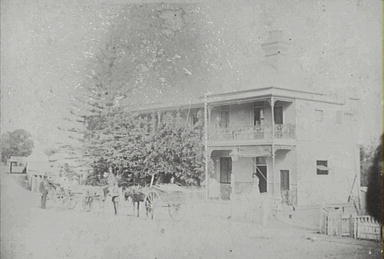
With his increasing prosperity James Hunter, like many other Sydney businessmen at the time, decided eventually to buy land in the Blue Mountains and build a country residence. At the end of the 1880s he purchased 60 acres at Springwood, with a frontage along the Western Road (now Macquarie Road), extending east from and including the Springwood Hotel built by Frank Raymond in 1877. He completely rebuilt the old hotel and opened it in January 1891 as The Oriental.

In the orchard adjoining the hotel Lawson next began construction of a cottage that was completed in 1892 and became known as Braemar. The Lawson’s appear to have occupied Braemar for no more than a couple of years, moving sometime in the mid-1890s into another home they had built next door.

This home, Glen Lawson, became James and Emma’s permanent residence for the rest of their lives. James Hunter built extensively in Springwood and settled a large extended family around him and his wife. On the eve of a trip to Europe in May 1900, he was praised in the press for contributing to the progress of the town ‘by erecting substantial buildings that would be a credit to any district’.

The Lawson’s were active in the Presbyterian Church (some services were held on the veranda of Braemar before the Frazer Memorial Church was opened) and in the movement to establish a School of Arts in Springwood.  In 1926, following a period of gradually declining health, James Hunter died on Friday 23 April. He was 90 years old. Within 24 hours his widow, Emma, who had appeared to be in fair health, had also passed away. The couple were buried together in Rookwood Cemetery.

John Low
Taken from: The Making of a Mountain Community, A Biographical Dictionary of the Springwood District 


Braemar c1990s

Saturday, June 11, 2011

Early Residents - James Tanner

Although it is generally claimed that Thomas Boland was Springwood’s first stationmaster and this occupation is listed for him on some family documents, it was James Tanner, his son-in-law, who was the first officially appointed Stationmaster, taking up this appointment on 1 January 1883 at an annual salary of £150. Prior to this date Springwood was only listed as Springwood Platform with E. Fishlock in charge.
James was born in Temple Bar in about 1831, parents James, a hairdresser, and Eleanor, nee Higham. He married Ellen Louisa Boland in 1864 in Sydney and commenced working for the Railway in 1876. Ellen and James were said to have had 8 children although we can only find 7 listed in the birth registration records: Ernest J. 1866, Maude Mary 1870, Frank 1872, Paul 1875, Ellen Ruth 1878, Roger Bede 1880 and Naomi Agatha 1883, all born in Sydney.

Reading through the Springwood reports in the Nepean Times, however, there is often mention of James Tanner junior. There is also mention of a Master Edgar Tanner captaining a cricket team in 1883 and adding to the success of the Springwood Literary and Debating Club concert in 1887. We can find no official record of an Edgar Tanner either. Were the Bolands continuing with their habit of swapping names?
In 1883, James was in trouble with public education authorities and appeared in court in February, charged with failing to send to school a female child for whom he was a guardian. He pleaded not guilty, stating that the child was in his employ with the permission of her parents and his agreement with them was that she was to receive clothing and accommodation with no mention of school. He said that he was certainly not her guardian. She was receiving basic instruction in reading, writing and arithmentic from members of the Tanner family. The schoolteacher, Mr Schowe, said she was not educated to the required standard, but the magistrate ruled that James had done his duty by her and dismissed the charge.

In 1885, James was promoted to Rylstone and De Carteret Lockie replaced him at Springwood on 27 October of that year. It appears, however, that some of the family continued living in Springwood with Frank Tanner being mentioned in the cricket news in 1890 and 1891. Frank was also lost with another young man in Sassafras the same year, but it was not until April 1892 that it was reported that ‘an old time resident has returned to reside here’. James had retired from the Railway and he and his family were occupying a cottage opposite the Station.

James Tanner now became involved with the Springwood Progress Association and was elected to a Committee to find a suitable site for a hall, and was later elected to a Committee of Management. He and several of his children were very musical and he is often mentioned as being the accompanist at concerts, as well as at the Hughes’ surprise party. At concerts Frank and Roger played the piano and Paul the violin and singing, while James junior played the piccolo. One concert report referred to him as James Tanner KTW (Knight of the Tin Whistle). In April 1895, the Times reported:
A party of our enthusiastic young residents started on Tuesday night by train to Katoomba from which point they intend ‘stumping’ it to the Jenolan Caves and back—Percy Croucher, Pat Ryan Jnr and Jas Tanner. They have gone fully equipped with a penny whistle and a banjo, so they will march with martial music.

The Tanner girls had their share of musical talent, too. At a Cricket Club concert Miss May (Maude Mary?) performed the ‘Skipping Rope Dance’ and the ‘Fan Dance’. On another occasion it was said that Miss Naomi Tanner sang very sweetly ‘Hazel Dell’. The reporter awarded her first place for singing.

In April 1902 the Nepean Times reported that Mr Tanner was very ill and unable to leave his bed. He died a few days after this at the age of 71. Ellen died in 1925. 

From The Making Of A Mountain Community, A Biographical Dictionary of the Springwood District.

More on James Tanner
His death was recorded in the Sydney Morning Herald 8.5.1902.  The newspaper stating that James Tanner, a native of London, died at his Springwood residence.  He was connected to the ‘mechanical staff of the Sydney Morning Herald’ before entering Government Service.  He was a stationmaster at Springwood where he remained for 14 years before removing to Rylstone. 

Sketch of first Railway Station at Springwood

Goods Train at Springwood Railway crossing c1880


Early Residents - William Martyn Publican

 William acquired the license of The Springwood Hotel c1870, whereby he acted as both publican and postmaster until the postal service was moved to the railway station c1880.


Springwood Hotel

In March 1882 he applied for an extension of the hotel license to enable him to hold a sports day and dancing on Easter Monday. He assured the bench that ‘only married people would be present’. The extension was granted without objection enabling him to open the hotel between 6am until 8pm.

William was involved in July and August 1882, with several other Springwood residents (including Thomas Boland) in a proposed coal exploration scheme, and subscribed five pounds. However the scheme remained just that!  In 1883 a John Marsh applied for the license to the Springwood Hotel but the license was refused because of bad behaviour at previous hotels.  The license remained in the hands of William.

Mrs Martyn died in May 1884, casting a gloom over Springwood. A news article at the time said that she was beloved by all who knew her for her kindness of heart. It is uncertain when William died or if they had children.

Pamela Smith

From: The Making Of A Mountain Community, A Biographical Dictionary of the Springwood District


Saturday, March 19, 2011

Early Residents: Mark & Ruth Thew

The 1868-70 electoral roll listed Mark living at Faulconbridge.  He was born at Port Stephens in 1828, and in 1857 married Ruth Slapp in a double ceremony with brother Thomas who married Mary Ann Slapp.

Ruth, Mary Ann and parents arrived in Australia in 1841 aboard the Canton.  Mr. Slapp was a gardener by trade but is reputed to have owned the Springwood Inn c1865.  However, recent evidence confirms that Robert Slapp had a 3 year lease on the Springwood Inn owned by Thomas Boland c1863.  Boland was in the process of selling the property but was unsuccessful. The family moved to a property at Rylestone in 1877.

Mark and Ruth moved to Lambing Flats to witness the riots that occurred there in 1861.  Twin boys, John Thomas and Robert Mark, were born in Springwood in 1865.  Kerry Thew, who operated a chemist shop at Faulconbridge for several years, is the grandson of John Thomas Thew.  Mark and Ruth settled in Blackheath c1895.

* This article was taken from The Making Of A Mountain Community: a Biographical Dictionary of the Springwood District

Early Residents: John Thomas Ellison

John Thomas Ellison war born at Parramatta 15th July 1841.  His grandfather, also John, was transported to Australia in 1791 on the Albermarle and became the publican of the 'Bird In Hand' (1817) and the 'Jolly Sailor' in Parramatta. His son Thomas continued in the trade and owned the 'Native Lass' on Lapstone Hill and the 'Toll Bar' Inn at Linden. He married Elizabeth Huff in 1840 at St John's Church Parramatta and John Thomas was their first child.

John lived with his parents at Toll Bar Inn was demolished for railway purposes in 1863, they moved to the 'Arms of Australia' in Emu (present day Emu Plains) and the 'Union Inn' Penrith. He married Hannah Lees, daughter of Cornelius and Henrietta Lees of Springwood in 1871. They had ten children: Beckie, Albert, Thomas, Lizzie, Ivy, Leslie, Lilly, Cecil, Sarah and Hannah, Henrietta.

After marriage John purchased land and established an orchard on Hawkesbury Road Springwood, which is the site of the present day Springwood Golf Club.  It is believed that a pear tree still growing near the professionals' shop was planted in the time of Ellison.

John & Hannah Ellison

The farmhouse was situated approximately where the present clubhouse now stands and was reputed to have been constructed of stone salvaged from the Toll Bar Inn Linden. He established a sizeable orchard, growing oranges and summer fruits. When the nearby Lawson estate was advertised for sale in 1890 it was said to be close to desirable properties including Mr. J.T. Ellison's famous orangery and stone fruit orchard.

* This article is part of a larger article taken from The Making of a Mountain Community: a Biographical Dictionary of the Springwood District

Thursday, March 17, 2011

Early Residents: Coyle family, three generations

Thomas and Bridget were the first generation of Coyle's to live in the Springwood district.  It is believed they had four children namely John (James?), Mary Amee born c1862, Louisa and Jane born c1866.  Thomas is listed on the 1868-70 electoral roll, however, it seems that he may have died between then and the 1891 census because only Bridget was listed.  In 1876, son John  was responsible for supporting the establishment of a primary school in Springwood and listed the names of his younger siblings.  John was probably working to support the family.

Mary Coyle is thought to have married Patrick Cummins, the licensee of the Royal Hotel, in 1884.  John married Theresa Helen/Helena Lawrence in 1886.  She was the daughter of Samuel and Ann Lawrence who lived on Hawkesbury Road.  Louisa Coyle married Theresa's brother Frederick the following year. 

John, a quarryman, and Theresa had three children; Thomas born c1887, John born c1888 and Mary born c1892.  Tragedy struck in 1893, when John passed away after a sudden and very short illness.  He was buried in McCarthy's Cemetery Cranebrook.  

The Nepean Times attested to his integrity, suggesting he had been hardworking, and in every respect a good citizen.  The family, including his widowed mother, were left in straightened circumstances so residents of the district arranged a fund raising benefit.  The event was held on the premises of Mr Stace the local blacksmith.

More on the Coyle Family

John and Theresa’s children were Thomas, born in Springwood in 1887; Mary A. (Molly), born in 1892, and John S. (Jack) born in Springwood in 1888.  Molly (later Mrs Frazer) became a dressmaker in Springwood before marrying and moving to Melbourne.  Jack was educated in Springwood and became an experienced bushman. He married Ethel Quinn in a quiet ceremony in 1921, and they lived at 17 Raymond Road, Springwood. Ethel was the only daughter of Mr and Mrs Quinn of Melbourne.
Jack was a crack shot, and he and his brother went on shooting expeditions. Akin to his mother, Jack was a lover of bush birds, flowers and animals, and many received this nature lover’s daily attention. Perhaps due to the influence of his mother, Jack developed a talent for breeding lyrebirds in captivity, and held the distinction of being the first to ever do so. He held a license to breed the birds and they became a source of local pride and admiration. He was a member of the football club in 1900, and in 1911 was voted the ‘handsomest man’ in a fundraiser to aid the Catholic Church.

It is believed that Jack was the subject of a painting produced by well-known artist Wynne Davies. The painting, which hung in the Springwood School of Arts building for many years, was a bush scene, and depicted Jack talking to two small boys. Anecdotal information says that the painting was put in the Royal Hotel when the School of Arts was demolished. Licensees have since come and gone, and recent investigations have failed to locate the painting’s whereabouts.

A 1924 edition of the Nepean Times carried a story headed ‘Woman’s Tears—a Springwood House’, and went on to relate a case that had gone before the court whereby Ethel Coyle had pleaded guilty to the charge of using the house known as The Pines for the purpose of gaming. She stated, when interviewed, that her husband was caretaker for Mr Stewart Dawson at his country residence and the bookmaking was a sideline of hers. Ethel was fined £40 and an amount of £9 was retained from £18 seized by Sergeant Gimbert. Ethel was made to give surety that she would ‘cut this business right out’.

Anecdotal information says that John and Ethel supplied Norman and Rose Lindsay with enough sandstone to finish off their home in Chapman Parade, Faulconbridge. Lindsay is thought to have given them several paintings in return for the favour. However, Ethel burnt all but one because she objected to the nudes.  Jack and Ethel were champion ‘old time waltzer’s’ of the mountains and held the title for 25 years.

Jack worked for Stewart Dawson for approximately 15 years.  Like his father and grandfather before him, Jack died at the very young age of 50. His obituary appeared in the Nepean Times dated 8.6.1939, and it would seem that Jack’s death was the result of an accident sustained while working at St. Columba’s College. He is buried beside his mother Theresa, wife Ethel (died 1972) and brother Thomas (died 1951) in the Catholic section of Springwood Cemetery.

Pamela Smith

From The Making of a Mountain Community: a Biographical Dictionary of the Springwood District.

Saturday, February 26, 2011

Early Residents – William Deemer & W.T. Dickson

William Deemer is thought to have been the same William Deemer who applied for the license of the Springwood Hotel (later re-built and renamed the Oriental Hotel by James Hunter Lawson) in June 1885.  An objection was made to the court regarding his application for the license because he had a charge of intoxication against him.  However, the court was lenient and the license was granted.  William is thought to have married Adelaide C. Smith in 1861 and several children had been born prior to their move to Springwood.  William is thought to have retained the license until approximately 1888 when the Adams family took over the running of the hotel.
W.T. Dickson was the licensee of the Royal Hotel in 1884.  It would seem he brought a good deal of experience in the hotel industry when he came to Springwood because he was late of the York Hotel situated in York Street, Sydney.  His stay was short because 1885-6 the license was in the name of Mary Ann Brown.    
Royal Hotel Great Western Road (now Macquarie Road)